
A fresh coat of paint will not hide termite damage, and a one-off spray will not give most properties the level of defence they actually need. The right termite treatment options depend on where the risk sits – in the soil, inside the structure, or in the design of the building itself – and whether you are protecting a new build, managing an existing home, or responding to active termites.
For homeowners and builders, that distinction matters. Some systems are built for prevention from day one. Others are designed to stop active attack and hold the line over time. If you choose the wrong approach, you can spend money without securing the structure.
Why termite treatment options are not all equal
Termite work is often talked about as if it is just pest control. It is not. Effective termite protection is closer to engineered risk management. The goal is not simply to kill a few insects you can see. The goal is to break termite access to the building, detect activity early, and maintain protection as conditions change.
That is why there is no single best answer for every property. A slab-on-ground home in Western Sydney may need a very different approach from a renovation in the North Shore, or a new build in a coastal area where moisture and landscaping can complicate the barrier zone. Soil type, construction style, drainage, previous treatment history, and whether a reticulation system is already installed all change the decision.
Pre-construction termite treatment options
If you are building, this is where the strongest protection usually starts. Pre-construction systems give you the chance to defend the structure before access is restricted by slabs, paving, driveways, and finished landscaping.
Physical termite barriers
Physical barriers are installed as part of the building system to make concealed termite entry much harder. Depending on the product, this can involve graded stone, metal components, or flexible sheet systems integrated around penetrations, joints, and critical access points.
The main advantage is durability. A properly selected and correctly installed physical barrier can provide long-term protection without relying on repeated broad chemical application. The trade-off is that it must be designed and installed with precision. If detailing is poor around service penetrations or slab edges, weak points can remain.
For builders and architects, physical systems can be attractive because they integrate into compliance requirements and can support a more permanent defence strategy. For owners, they offer confidence that protection was considered before the building was closed in.
Chemical soil treatments before the slab
Chemical soil treatments create a treated zone in the soil that termites must pass through or avoid. Applied before slab pour and at key perimeter areas, they remain one of the most common pre-construction termite treatment options in Australia.
When specified properly, chemical barriers can be highly effective. They are also practical for many project types. But they are not set-and-forget forever. Product life, soil disturbance, drainage issues, excavations, and later building works can all affect performance. That is why inspection and maintenance still matter, even where a chemical barrier has been installed.
Reticulation systems for refillable protection
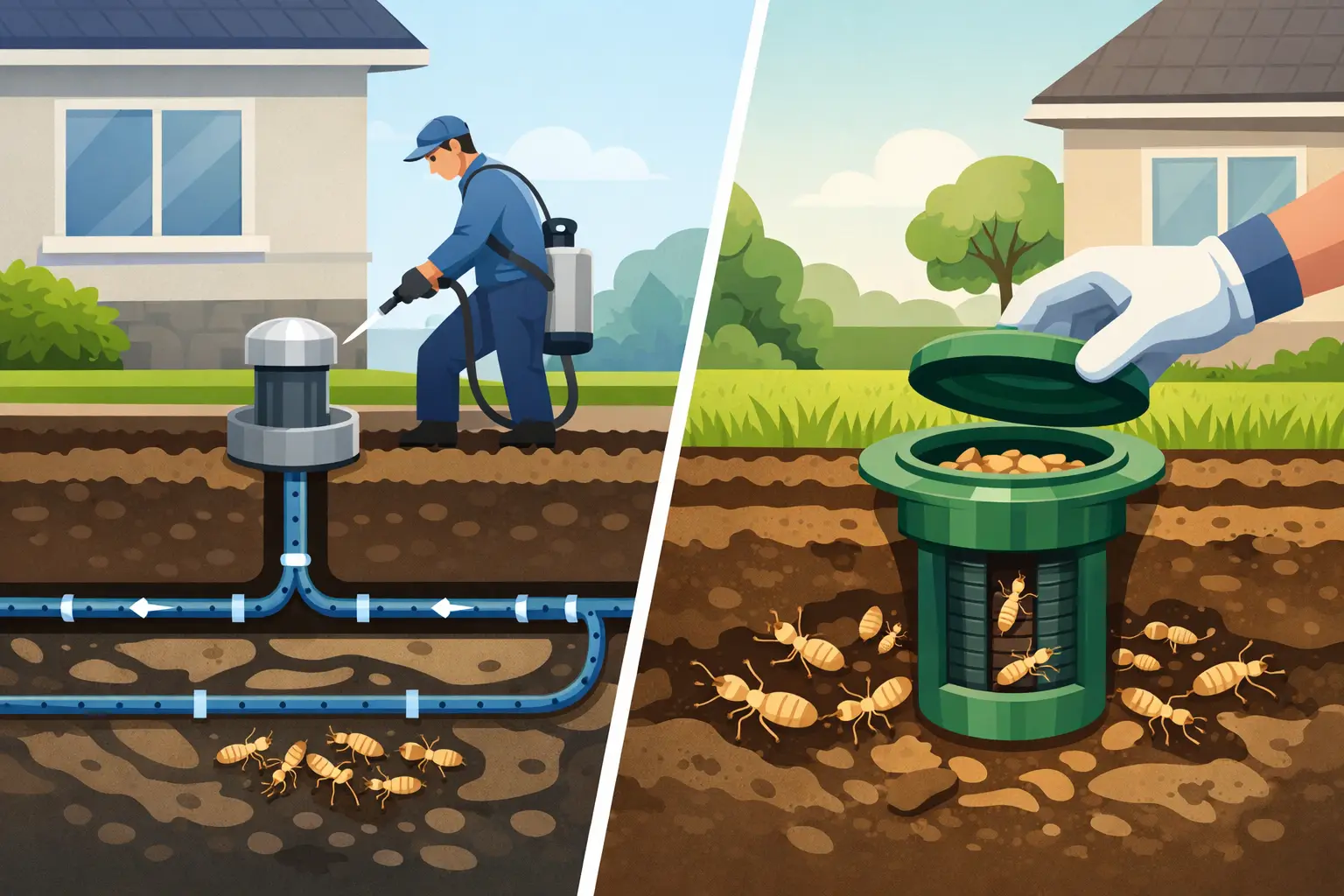
Reticulation systems are designed so the chemical barrier can be replenished through installed pipework without invasive trenching each time. For many new homes, this is one of the most practical ways to support long-term treatment continuity.
This matters because barriers do not stay at peak performance indefinitely. If a property already has a refillable system, owners often ask about termite reticulation recharge cost, how much to refill termite system, or termite barrier recharge price Sydney. The real answer depends on the size of the home, the system brand, accessibility, and the product used for the recharge. What matters more than a rough figure is whether the recharge is carried out to the correct volume, pressure, and product specification so the protective zone is properly reinstated.
Termite treatment options for existing homes
Once a home is built, treatment becomes more property-specific. Access is more limited, landscaping may cover critical areas, and the immediate issue may be either prevention or active infestation.
Chemical perimeter and soil barriers
For established homes, a chemical soil treatment around the perimeter is often used to create a defensive zone. This can be effective where access allows continuous treatment and where the structure design supports barrier continuity.
The limitation is simple – not every site gives perfect access. Paths, patios, garages, retaining walls, extensions, and dense garden beds can all interrupt treatment lines. In those cases, a specialist should assess whether the barrier can be completed to standard or whether another method should support it.
Termite baiting and monitoring systems
Baiting systems work differently. Rather than relying on a continuous treated soil zone, they use strategically placed stations to intercept foraging termites and deliver a slow-acting toxicant back through the colony.
Baiting can be a strong option where conventional barrier work is restricted or where active termites need to be managed with minimal disturbance. It can also suit complex sites. The trade-off is that it requires ongoing monitoring. A bait station no one checks is not a defence plan. It is just plastic in the ground.
Direct treatment of active workings
When termites are already in the structure, direct treatment may be used to suppress active areas. This can involve targeted application to affected timbers, wall voids, or known activity points.
Direct treatment can be useful as part of an immediate response, but it is rarely enough on its own. Killing visible termites does not necessarily address hidden entry points or the larger colony pressure around the property. In most cases, direct treatment should sit within a bigger protection strategy that includes a barrier, baiting, or both.
When a recharge is the right move
Many homes already have a termite reticulation system in place. In that case, the question is not which system to install from scratch, but whether the existing protection is due for replenishment.
If your barrier was designed to be refillable, recharge servicing can be the most efficient way to maintain defence without tearing up finished areas. For owners searching termite reticulation recharge near me or pest control Sydney reticulation refill, the key issue is not just finding someone who can pump product into the line. It is making sure the contractor understands the system brand, charging method, product compatibility, and service history.
A reticulation recharge should be based on the installed system, the age of the previous treatment, the property layout, and the inspection findings. If there are signs of soil movement, landscaping changes, plumbing works, or additions to the home, those issues need to be considered before assuming a simple refill is enough.
How to choose between termite treatment options
The best decision usually comes down to three questions. Are you preventing future attack, dealing with active termites, or maintaining an existing barrier system? Is the property a new build or an established structure? And can the chosen method be maintained properly over time?
A new build often benefits from integrated protection – physical barrier components, chemical treatment where appropriate, and a refillable system that makes future maintenance easier. An existing home may need a combination of inspection findings, targeted treatment, and either barrier work or monitored baiting depending on access. A property with an older reticulation system may simply need competent recharge servicing to restore the intended level of defence.
Price matters, but cheapest is rarely safest in termite work. A low-cost treatment that leaves untreated gaps, uses the wrong product, or ignores follow-up requirements can become the expensive option very quickly if structural damage continues.
What a proper treatment plan should include
Any serious termite protection plan should start with a detailed inspection. Without that, recommendations are guesswork. The inspection should identify current activity, likely entry points, construction risk factors, moisture issues, and the feasibility of each treatment type.
From there, the recommended treatment should be matched to the property, not forced into a one-size-fits-all package. Homeowners need plain advice on what the treatment does, what it does not do, how long protection is expected to perform, and what maintenance is required. Builders and specifiers need compliant installation, clean documentation, and systems that work with the build program rather than against it.
That is where specialist termite contractors separate themselves from general pest sprayers. The work is not just about application. It is about maintaining a defendable structure over time.
If you are weighing termite treatment options, treat the decision like structural protection, not routine pest control. The right system should fit the building, remain serviceable, and give you a clear path to ongoing defence. If there is any doubt, book the inspection first and make the next step based on evidence, not assumptions.