
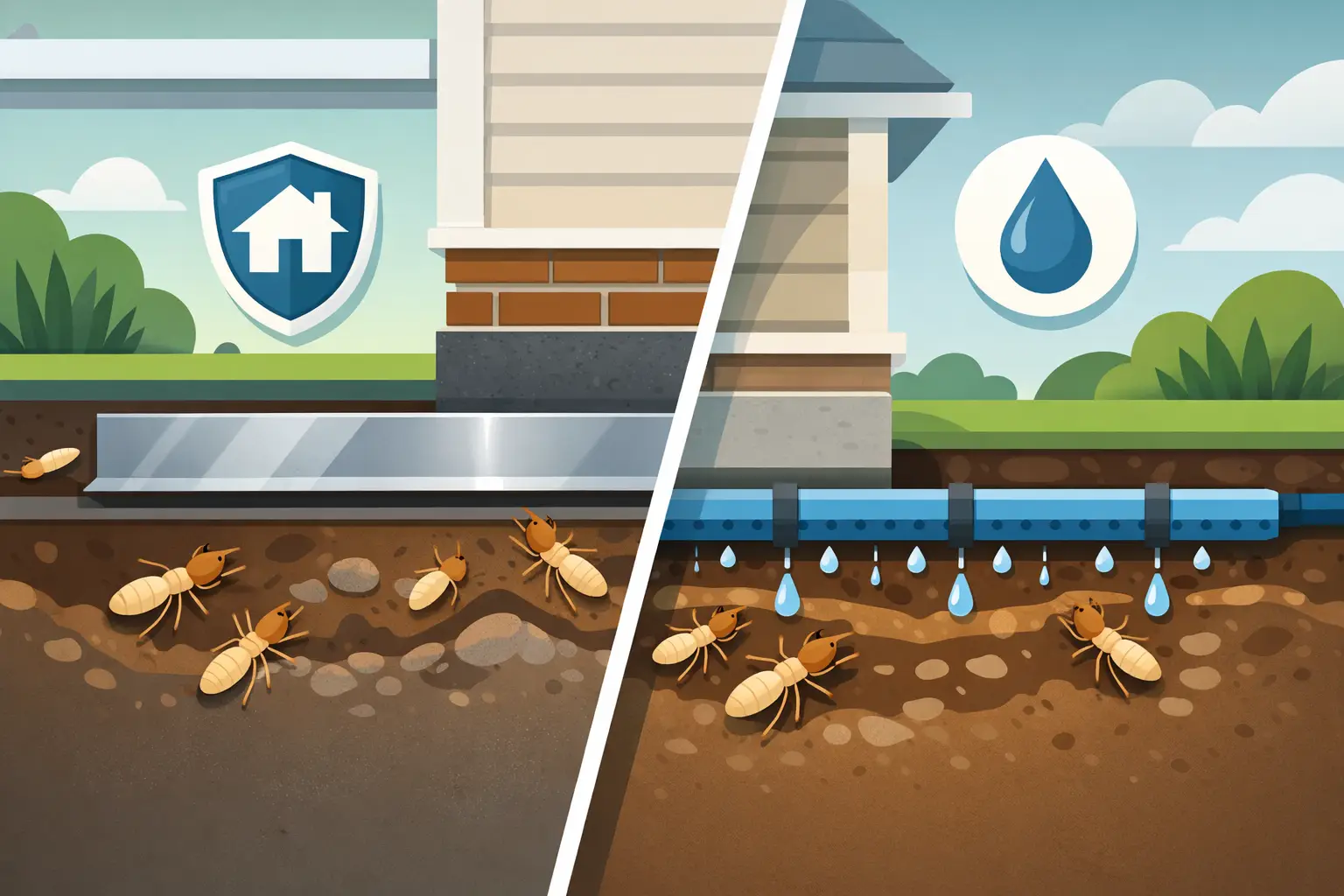
If you’re weighing up termite barrier vs reticulation, you’re already asking the right question. The wrong system can leave a hidden gap in your defence, lock you into avoidable maintenance issues, or cost more over the life of the property than it needed to. For Sydney homes and building projects, the better choice comes down to how the property is built, how accessible the treatment zone will be later, and whether you want one-off installation or a system that can be replenished without major disruption.
Termite barrier vs reticulation – what is the difference?
A termite barrier is the broad category. It refers to the protective system installed to stop or deter concealed termite entry into the building. That can include physical barriers, chemical soil treatments, or integrated systems designed into the construction.
A reticulation system is more specific. It is a replenishable delivery system installed around the perimeter, and sometimes critical internal zones, that allows termiticide to be recharged into the soil later through installed lines and ports. In plain terms, reticulation is not the whole strategy by itself – it is usually the method used to maintain a chemical barrier over time.
That distinction matters. People often compare them as if they are direct opposites, but in practice reticulation is one type of termite protection approach within the wider barrier category. The real comparison is usually between a conventional barrier treatment and a replenishable reticulation-based barrier.
Where standard termite barriers make sense
A conventional termite barrier can be an excellent option when the building design allows a complete treatment zone to be installed properly and kept compliant. On new builds, that might mean a physical barrier under slab penetrations, around joints, or as part of the perimeter detail. On existing homes, it may mean a chemical soil treatment applied directly into the soil against the footing line.
The strength of this approach is simplicity. If the barrier is installed correctly, to Australian standards and to suit the construction type, it creates an immediate line of defence without the extra components of a refill system. For many homes, particularly where access to the perimeter soil is straightforward, this is a practical and cost-effective path.
The trade-off is future access. If the original chemical treatment degrades over time, replenishment may require fresh trenching, drilling, or more invasive work. That is where some property owners discover that the cheaper install was not necessarily the lower whole-of-life cost.
When reticulation is the smarter choice
Reticulation systems are designed for long-term serviceability. Instead of starting again when the chemical needs replenishing, the system can be recharged through installed pipework. For builders and owners thinking beyond handover, that can be a major advantage.
This is particularly useful on homes with extensive paving, finished landscaping, tight access, or construction details that make future soil treatment difficult. Once those areas are completed, traditional re-treatment can become messy, disruptive, or expensive. A replenishable system reduces that problem because the infrastructure is already in place.
For homeowners planning to stay in the property, reticulation offers a clearer maintenance pathway. For builders, it can also support a more engineered termite defence strategy rather than relying on a basic spray and hoping future access remains easy.
Which system gives better protection?
Protection does not come down to marketing claims. It comes down to coverage, suitability, maintenance, and whether the installed system remains effective over time.
A well-designed physical or chemical barrier can provide excellent protection when installed correctly and inspected regularly. A reticulation system can also provide strong long-term defence, but only if it is serviced and recharged at the right intervals with the correct termiticide. An unmaintained reticulation system is not a better system – it is simply pipework around a vulnerable home.
That is why the better question is not which option is stronger in theory. It is which option is more likely to stay effective on your property over the next five, ten, or fifteen years. On many Sydney homes, especially where hard landscaping limits future access, reticulation often wins on maintainability.
Cost now versus cost later
This is where many decisions go wrong. Owners focus on the install figure and overlook the servicing path.
A standard barrier may cost less upfront, depending on the property and the system selected. A reticulation system often carries a higher initial installation cost because of the materials, layout, and planning involved. But if the property will be difficult to retreat later, that extra upfront spend can protect you from larger future costs.
The terms people usually search for tell the story: termite reticulation recharge cost, how much to refill termite system, termite barrier recharge price Sydney, termite reticulation recharge near me, and pest control Sydney reticulation refill. Those questions come up because recharge costs matter, but so does the alternative. If a conventional barrier needs renewal and access is poor, you may be paying for more labour, more disruption, and in some cases compromised treatment reach.
So which is cheaper? It depends on the site. If retreatment access will stay easy, a conventional barrier may be more economical. If future access is likely to be restricted by paths, driveways, entertaining areas, retaining walls, or mature gardens, reticulation can be the stronger financial decision over time.
Compliance, construction stage, and the reality on site
For new construction, this decision should be made early, not once the slab is down and the trades are moving. The right termite system needs to work with the building design, slab detail, penetrations, landscaping plan, and certification requirements.
Builders and architects generally benefit from systems that are clear to document, practical to install, and straightforward to service after handover. That is one reason replenishable systems remain popular on certain projects. They allow for ongoing defence without having to disturb finished works later.
For existing homes, the calculation is different. You are dealing with the house as it stands, not the ideal version on the plan. Access, drainage, concrete edges, subfloor conditions, and previous termite activity all affect what is realistic. In some homes, a full reticulation install is the better long-term move. In others, a targeted barrier treatment with ongoing inspections is the more practical answer.
Maintenance is not optional
This is where a lot of termite protection fails. Owners assume installation equals permanent protection. It does not.
Physical barriers still require inspection because termites exploit gaps, bridging, and construction changes. Chemical barriers need monitoring because termiticide performance changes over time. Reticulation systems need scheduled recharge and verification that the system is delivering product correctly.
If you install reticulation but never service it, you have not solved the problem. If you apply a conventional treatment and ignore inspection intervals, you have not solved it either. Effective termite defence is a program, not a once-and-done purchase.
Who should choose what?
If you are building a new home and want a system designed for long-term access and repeat servicing, reticulation deserves serious consideration. It is especially strong where the finished property will have heavy paving or limited future treatment access.
If you own an established home with open perimeter access and a straightforward soil treatment zone, a conventional barrier may be the cleaner and more economical option. If the home has a complex footprint, additions, or hard-to-reach sections, a replenishable system may be the safer long-term call.
If you are buying a property, do not assume the existing system is current or compliant. Ask what type of barrier is in place, when it was last serviced, whether a reticulation recharge has been carried out, and whether inspection records exist. That information matters far more than a sales claim that the home is “protected”.
The best decision is the one that can still be defended later
There is no one-size-fits-all winner in termite barrier vs reticulation. The right choice depends on build stage, site access, maintenance planning, and how seriously you take long-term structural risk. What should not be up for debate is the need for a protection system that can be installed properly, inspected regularly, and maintained without excuses.
That is the standard worth holding. Because when termites find a gap, they do not care whether the original option looked cheaper on paper.