If you’re building a home, one of the most expensive mistakes is assuming termite protection is a set-and-forget job. A lot of owners and even some builders ask how long does pre construction termite treatment last, expecting a single number. The real answer is that it depends on the system installed, the soil conditions, the quality of installation, and whether the protection was designed for long-term maintenance or just initial compliance.
How long does pre construction termite treatment last in real conditions?
Pre-construction termite treatment can last anywhere from a few years to several decades, depending on the barrier type. That is a wide range, but it reflects reality. A chemical soil treatment may have a different service life than a physical barrier, and a replenishable reticulation system is built around scheduled recharging rather than a one-time lifespan.
If you are looking for a practical benchmark, many pre-construction chemical treatments are expected to provide effective protection for around 5 to 8 years under normal conditions, though some products may perform longer when installed correctly and maintained as required. Physical termite barriers can remain effective much longer because they are not relying on a chemical concentration in the soil. In some cases, they are intended to last for the life of the structure, provided they stay intact and are not bridged, damaged, or altered during later building works.
That distinction matters. A treatment’s claimed lifespan is not the same as guaranteed protection in the field. Termite defense is only as strong as the weakest gap in the system.
The biggest factor is the type of termite system installed
Not all pre-construction treatments work the same way. Grouping them together causes confusion and can lead to missed inspections, expired warranties, or weakened protection around a new build.
Chemical soil treatments
These treatments are applied to the soil before the slab is poured or around critical construction zones. They create a treated zone designed to deter or eliminate termites as they move through the soil. Their lifespan depends on the active ingredient, soil pH, drainage, disturbance, and application quality.
Even with a high-performing termiticide, the treated zone can break down faster if the soil is heavily disturbed after installation, if drainage is poor, or if landscaping changes allow untreated pathways. That is why chemical systems should never be viewed as permanent just because they were installed during construction.
Physical termite barriers
Physical systems use stainless steel mesh, graded stone, impregnated membranes, or similar materials to block concealed termite entry. These systems do not rely on a chemical residue in the soil, so they can offer much longer protection. But they are not maintenance-free.
Their lifespan is tied to integrity. If later plumbing works, renovations, paving, garden beds, or slab penetrations compromise the barrier, the protection can fail long before the building does. A barrier that should last for decades can be defeated by one unsealed entry point.
Reticulation systems
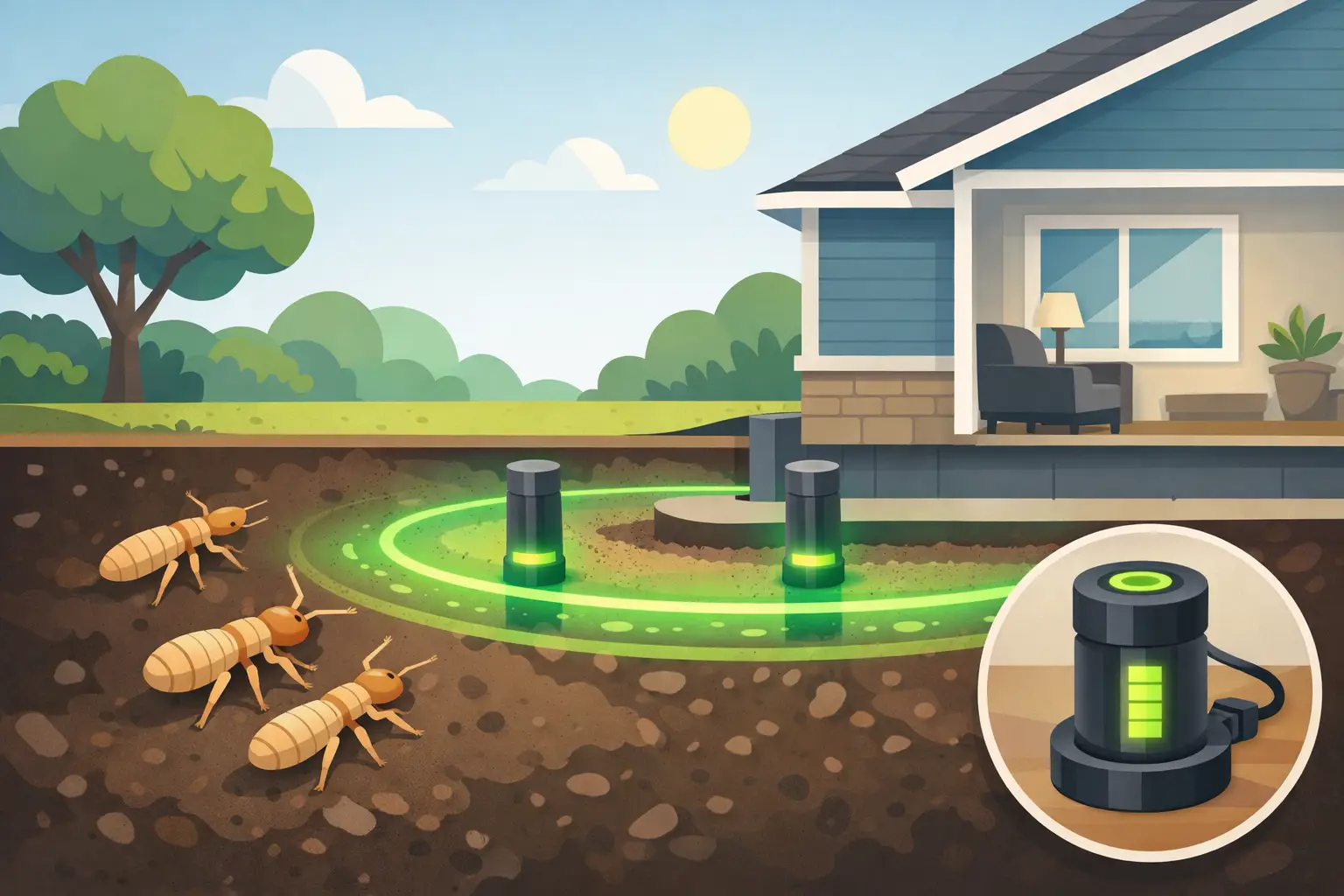
Reticulation systems are designed for refillable termite defense. Instead of relying on a one-off soil treatment that gradually loses strength, they allow termiticide to be reintroduced through installed pipework around the structure. This is one of the strongest long-term protection strategies because it is built for ongoing service.
In practical terms, the system itself may remain in place for many years, but the chemical inside it still requires periodic recharge. That means lifespan is not the right question on its own. Serviceability is just as important.
Why one house gets longer protection than another
Two homes built in the same year can have very different termite risk profiles five years later. That usually comes down to installation quality, site conditions, and what happened after handover.
Soil composition has a direct effect on treatment performance. Highly alkaline or reactive soils can reduce the effective life of some chemical products. Heavy rainfall, poor drainage, or water pooling near the slab can also weaken treated zones over time.
Construction detail matters too. Slab penetrations, step-downs, articulation joints, and service entries all need precise protection. If those areas are poorly treated or poorly sealed, termites do not need the whole barrier to fail. They only need one hidden access point.
Then there is post-construction disturbance. Driveways, retaining walls, trenching, garden edging, new plumbing, and even decorative landscaping can breach a termite barrier without the owner realizing it. This is one of the main reasons a treatment that looked sound at handover can be at risk years earlier than expected.
Warranty periods are not the same as treatment life
A lot of property owners assume that if a treatment came with a warranty, the warranty period tells them exactly how long the protection lasts. That is not always true.
Some warranties are conditional on annual inspections. Some apply only to specific systems or installation methods. Others may cover product performance but not damage caused by later building modifications, drainage issues, or barrier breaches. The paperwork matters, but so does the service history.
For builders and homeowners, the safest approach is to treat warranty terms as one part of the protection plan, not the whole plan. A standards-compliant installation still needs follow-up attention if you want dependable defense over the long term.
How to tell when pre-construction termite protection may be weakening
You usually cannot see a chemical barrier fading in the soil. That is what makes complacency expensive. By the time visible termite activity appears, the barrier may already be compromised.
Warning signs often come from changes around the property rather than the treatment itself. If the home has had excavation, landscaping, new paths, plumbing repairs, leaking drains, or structural additions, the original termite system should be reviewed. If nobody can confirm what type of barrier was installed, when it was installed, and whether it has ever been serviced or inspected, that is also a risk signal.
For reticulation systems, overdue recharge intervals are an obvious issue. For physical barriers, damaged seals or concealed bridging points can reduce effectiveness. For chemical treatments, the key risk is assuming the original application is still performing years later without any inspection evidence.
The role of inspections in long-term protection
The strongest termite defense strategy is not just installation. It is installation plus inspection plus maintenance. That is especially true in high-pressure termite areas where attack risk never really drops away.
Annual termite inspections help verify whether the barrier still appears intact, whether changes to the property have created vulnerabilities, and whether re-treatment or recharge should be scheduled. For builders, this protects the integrity of the installed system. For homeowners and buyers, it protects the asset itself.
This is where specialist providers separate themselves from general pest control. A basic spray mindset is short-term. Engineered termite protection looks at the full system, the slab edge detail, service penetrations, recharge access, compliance requirements, and the service path needed to keep the barrier effective.
So what should homeowners and builders expect?
Expect a pre-construction termite treatment to perform according to the system type, not according to wishful thinking. If it is a chemical soil treatment, plan for inspections and recognize that effective life is finite. If it is a physical barrier, protect its integrity and make sure later works do not defeat it. If it is a replenishable reticulation system, keep it on a proper recharge schedule.
For new builds, it is worth asking four direct questions before handover: what system was installed, where it was installed, what the maintenance requirements are, and what records need to be kept for warranty and future servicing. Those answers matter more than a broad promise that the home is protected.
For existing owners who did not build the property, it is smart to verify the barrier type rather than guessing. A specialist inspection can identify whether the home has a chemical treatment, a physical system, a refillable reticulation setup, or gaps that need attention. That gives you something solid to act on instead of relying on assumptions.
At Termiguard, that long-view approach is exactly the point. Pre-construction termite treatment should not be treated as a box to tick during the build. It should be installed, documented, inspected, and maintained as part of the building’s ongoing defense system.
A termite barrier lasts longest when it is treated like structural protection, not a one-time spray. If you want the protection to hold, keep the system visible on your maintenance radar long after the slab has cured.